Upper Zone in Handwriting Analysis – Complete Guide
Handwriting is more than a method of writing words; it is a reflection of the human mind and personality. In graphology, the Upper Zone plays a crucial role in understanding a person’s intelligence, imagination, thought process, and emotional balance. This article explains the Upper Zone in detail along with its major types.
What Is the Upper Zone?
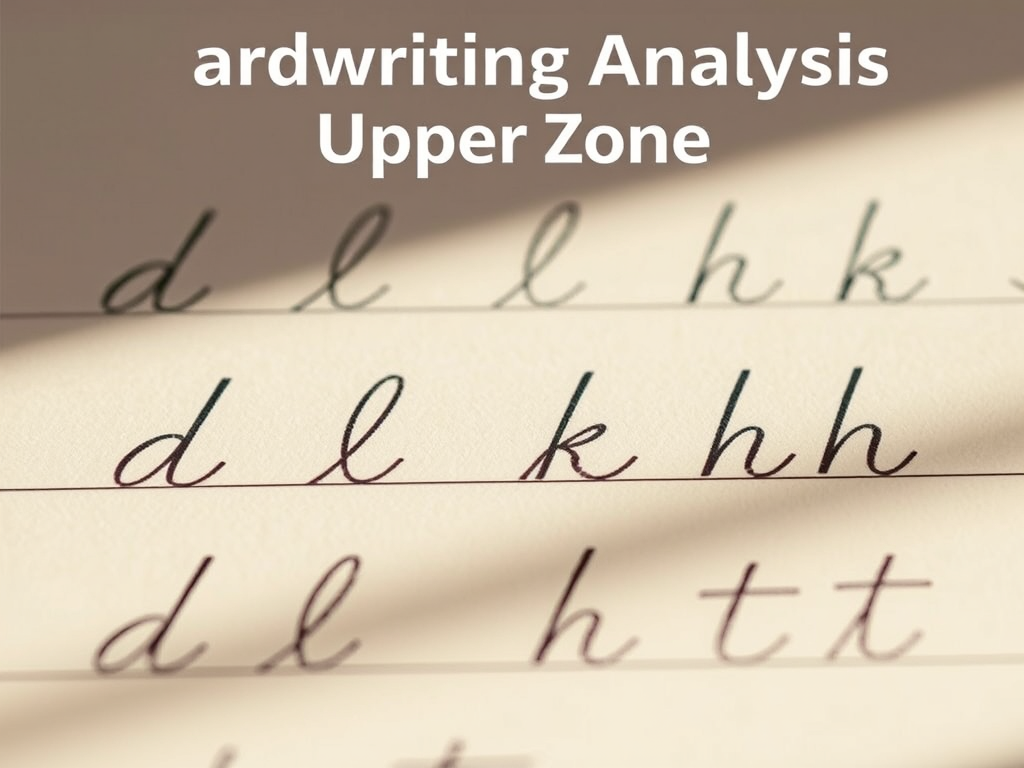
The Upper Zone consists of all strokes and curves written above the baseline of handwriting.
Letters such as d, l, k, h, and t mainly represent this zone.
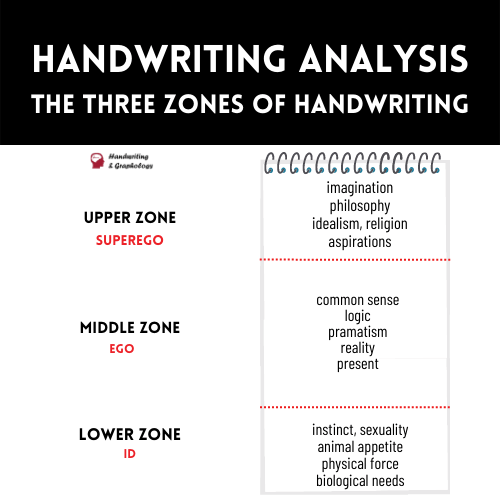
In a single-line copy:
- Writing above the line forms the Upper Zone
- Writing on the line forms the Middle Zone
- Writing below the line forms the Lower Zone
The development of the upper zone reflects how a person thinks, plans, imagines, and processes ideas.
Prominent Upper Zone


A Prominent Upper Zone appears when the upward strokes of letters are clearly visible and larger than normal, while still remaining balanced with the middle and lower zones.
Indications:
- Strong intelligence and mental clarity
- Quick learning ability and good memory
- High academic and professional performance
- Strategic and business-oriented thinking
- Strong creativity and imagination
- Ability to influence and motivate others
Such individuals often achieve success through ideas, planning, and vision.
2. Overly Prominent Upper Zone
An Overly Prominent Upper Zone is observed when the upper strokes are extremely long and dominate the middle and lower zones.
Indications:
- Emotional dominance over logic
- Weak or inconsistent decision-making
- Strong theoretical knowledge but poor practical execution
- Difficulty applying ideas in real-life situations
- Possible emotional or mental imbalance in extreme cases
These individuals may understand concepts well but struggle to implement them effectively.
3. Words Looking Like a Stick

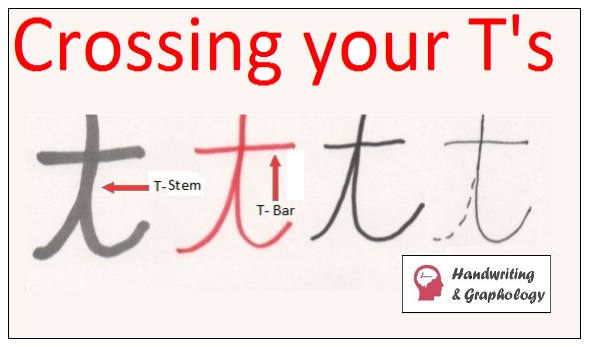
This pattern is seen when letters, especially ‘t’, are written with a straight vertical stroke first, giving the handwriting a stiff or stick-like appearance.
Indications:
- Practical and realistic outlook
- Logical and fact-based thinking
- Resistance to assumptions and unverified claims
- Preference for proof and evidence
- Strong sense of clarity in decision-making
Such people rely more on practical facts than on theories.
4. Backward-Formed Upper Zone

In this style, upper-zone letters such as ‘t’ or ‘s’ are formed using backward curves.
Indications:
- Shy and reserved nature
- Limited expression of intelligence and creativity
- Hesitation in expressing ideas
- Average intellectual development despite potential
- Emotional restraint and self-doubt
Although the handwriting may appear prominent, backward strokes reduce expressive strength.
5. Points in the Upper Zone


This occurs when a person places dots or points near upper-zone letters such as ‘h’ or ‘l’.
Indications:
- Presence of unique talents and special skills
- Artistic, musical, or sports-related abilities
- Strong individuality
- Selective social interaction
- Occasional feelings of loneliness due to self-perception as different
Such individuals often perform well in creative or specialized fields.
Conclusion
The Upper Zone represents the mental and imaginative side of a person’s personality. A balanced upper zone indicates intelligence combined with emotional stability, while extreme formations point toward imbalance.
Understanding the Upper Zone helps in self-awareness, personal development, and deeper handwriting analysis. In upcoming lessons, the Middle Zone and Lower Zone will be discussed to provide a complete understanding of handwriting zones.


